
Segmentation, Targeting, and Positioning Strategy for Small Business Competitive Advantage
- Tiane De Almeida
- Mar 2
- 6 min read

Updated: Mar 4

What You’ll Learn in This Guide
In this guide, we break down:
• What segmentation, targeting, and positioning (STP) really mean
• How market segmentation influences strategic advantage
• Why positioning strategy must move beyond messaging
• How STP connects to structural competitive advantage
• How AI changes targeting and differentiation
• How to apply STP in real business scenarios
• Why price differentiation strategy alone fails in a competitive market
Market Segmentation and Positioning Explained
Market segmentation divides customers into groups based on shared characteristics such as demographics, behavior, needs, or value potential. Positioning then defines how your business differentiates within that chosen segment.
However, segmentation and positioning are often misunderstood as purely communication tools. In reality, they are strategic allocation decisions that influence how resources, systems, and capabilities are structured.
Types of Market Segmentation
There are four primary types of market segmentation:
1. Demographic Segmentation
Grouping customers by age, income, occupation, or education.
2. Geographic Segmentation
Dividing markets by location or regional characteristics.
3. Psychographic Segmentation
Segmenting by lifestyle, values, attitudes, or motivations.
4. Behavioral Segmentation
Grouping customers based on purchasing behavior, usage patterns, or brand loyalty.
Effective market segmentation improves clarity. But clarity alone does not create competitive advantage. What matters is how segmentation informs structural decisions inside the business.
Positioning Strategy in Competitive Markets
A positioning strategy determines how your brand is perceived relative to competitors. Strong positioning aligns customer needs, value delivery, and operational capability.
Positioning strategy can take multiple forms:
• Value-based positioning
• Benefit-based positioning
• Competitor-based positioning
• Price-based positioning
Many businesses rely on a price differentiation strategy to compete. However, price-based positioning is rarely sustainable without structural support.
When positioning exists only at the messaging level, competitors can replicate it quickly.
True positioning power emerges when differentiation is embedded into operations, systems, and delivery.
Targeting Strategies Explained
Once segmentation is defined, targeting determines which segments a business chooses to serve.
There are four primary targeting strategies:
Undifferentiated Targeting – Serving the entire market with one offer.
Differentiated Targeting – Creating tailored offers for multiple segments.
Concentrated Targeting – Focusing deeply on one specific segment.
Micromarketing – Highly personalized targeting at small or individual levels.
Strategic targeting influences:
• Resource allocation
• Operational design
• Customer acquisition models
• Long-term scalability
In competitive markets, concentrated targeting combined with structural positioning often produces stronger defensibility than broad targeting.
Price Differentiation Strategy vs Structural Differentiation
Many businesses rely on a price differentiation strategy to compete. However, price-based positioning is rarely sustainable without structural support.
A strong segmentation, targeting, and positioning strategy helps small businesses move beyond basic marketing and build a real competitive advantage. By aligning customer segments, delivering targeted value, and differentiating through positioning, businesses can create structural advantages that are harder for competitors to replicate—especially in an AI-driven market where execution alone is no longer enough.
Read this to find out why: https://www.strategicbusinesslab.com/post/structural-competitive-advantage-the-complete-framework-for-small-businesses
How Can Segmentation, Targeting, and Positioning Provide Competitive Advantage?
Segmentation, targeting, and positioning (STP) are among the most widely taught frameworks in marketing.
They help businesses:
• Identify customer groups
• Select ideal markets
• Craft differentiated messaging
And when applied well, they improve clarity.
But clarity does not equal defensibility.
In today’s environment — where AI is compressing execution cost — positioning alone is no longer enough.
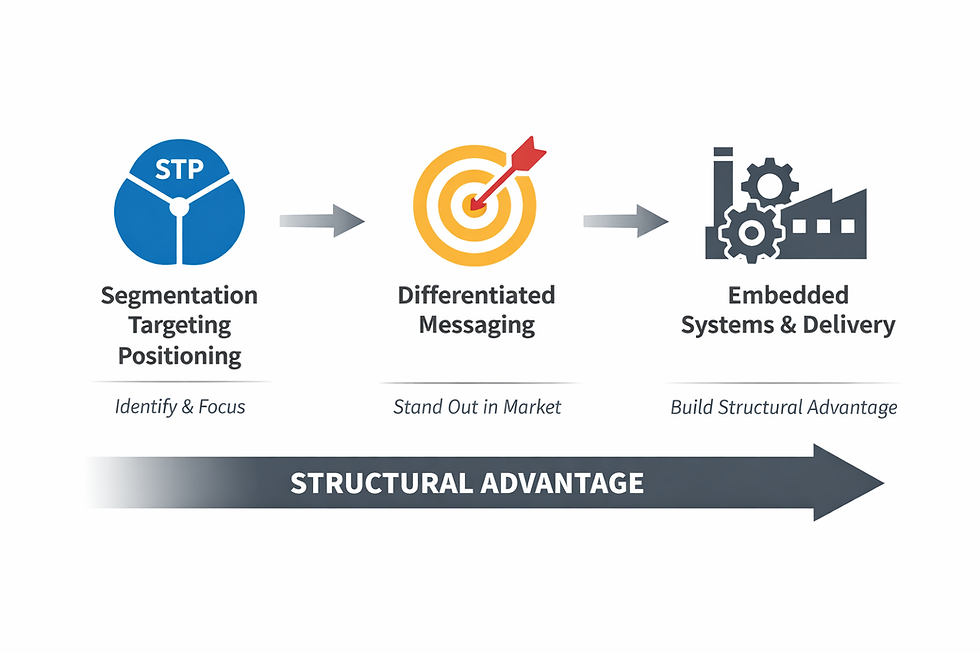
To create a real competitive advantage, STP must move beyond messaging into structure.
WHAT IS STP?

Segmentation, targeting, and positioning are a strategic marketing framework used to define:
Segmentation – Who exists in the market?
Targeting – Who you choose to serve
Positioning – How you differentiate
Traditionally, STP improves communication.
It helps businesses:
• Focus their efforts
• Tailor their value proposition
• Avoid generic messaging
However, most applications of STP stop here.
They optimize perception — not advantage.
WHY MOST BUSINESSES USE STP TACTICALLY
In practice, many businesses use STP to:
• Create niche messaging
• Adjust pricing perception
• Build brand tone
• Highlight features
This produces:
Short-term differentiation
But not long-term protection.
Competitors can:
• Copy messaging
• Replicate positioning
• Enter your segment
• Undercut pricing
Which leads to:
Price competition.
This is why many businesses feel differentiated — but still compete on cost.
Marketing evaluation and control help determine whether segmentation and positioning strategies are actually delivering results.
👉 Read how evaluation works here:
FROM POSITIONING TO STRUCTURE

Real advantage does not come from what you say.
It comes from what competitors cannot easily replicate.
Structural positioning embeds differentiation into:
• Systems
• Workflows
• Relationships
• Integration
Instead of:
“We serve X better.”
Structural STP becomes:
“Our model works differently.”
Examples of structural positioning include:
• Integrated service delivery
• Embedded client workflows
• Switching costs
• Data-driven personalization
These cannot be copied by rewriting a tagline.
Business Strategy Evaluation and STP
Segmentation, targeting, and positioning must align with broader business strategy evaluation.
If your business strategy is differentiation, your segmentation must support value-based positioning.
If your strategy is operational excellence, targeting must align with scalable segments.
STP is not just a marketing framework.
It is a strategic allocation system.
When evaluated correctly, STP becomes a mechanism for competitive architecture.
HOW AI CHANGES SEGMENTATION AND POSITIONING
AI reduces execution cost.
Which means:
• Faster imitation
• Faster entry
• Faster capability parity
In the past, execution created an advantage.
Today, execution is becoming accessible.
So the advantage shifts from:
What you do
To:
How your system is designed.
AI allows businesses to:
• Personalize at scale
• Integrate insights into delivery
• Reduce dependency on individuals
• Build adaptive targeting systems
• Automate evaluation and control
But only when STP is structurally embedded.
Otherwise, AI accelerates commoditization.
STRUCTURAL STP IN PRACTICE
Imagine a SaaS company targeting small marketing agencies.
Segmentation identifies agencies with fewer than 20 employees. Targeting focuses on agencies using AI tools but lacking performance evaluation systems. Positioning emphasizes strategic control and measurable performance improvement.
But structural STP goes further.
The SaaS platform integrates:
• Automated performance dashboards
• AI-driven recommendations
• Embedded reporting workflows
• Switching costs through data history
This demonstrates how segmentation, targeting, and positioning become operational decisions rather than just messaging.
Not just marketing.
This creates:
Reduced switching
Higher perceived value
Lower price sensitivity
Scalable Defensibility
And most importantly:
Defensibility.
STP vs Price Differentiation Strategy
A price differentiation strategy attempts to compete by lowering cost.
Structural STP competes by increasing the value embedded in systems.
Price can always be undercut.
Systems are harder to replicate.
This is the core difference between tactical marketing and strategic advantage.
WHY THIS MATTERS FOR SMALL BUSINESSES

Small businesses often rely on:
Effort
Expertise
Customization
But these are easy to replicate over time.
Structural positioning allows smaller firms to:
Compete without scale
Avoid price wars
Maintain differentiation
Build defensibility
Especially in a world where AI lowers the barriers to execution.
AI is compressing execution cost — which makes positioning alone insufficient without structural integration.
The question is no longer:
Are you differentiated?
But:
Is your differentiation defensible?
Most businesses believe they are positioned well.
Very few have tested whether that positioning creates a structural advantage.
Start with the Strategic Advantage Diagnostic and measure your current position.
As AI compresses execution cost, frameworks like segmentation and positioning must evolve into a structural advantage — a shift explored further in our Medium feature.
FAQ
What is a segmentation, targeting, and positioning strategy?
A segmentation targeting and positioning strategy is a marketing framework used to identify customer groups, choose which ones to serve, and define how your business differentiates itself in the market. It helps businesses focus their efforts and communicate value more effectively.
How does a segmentation, targeting, and positioning strategy create competitive advantage?
A segmentation-targeting and positioning strategy creates competitive advantage when it moves beyond messaging and becomes embedded in systems, workflows, and the customer experience. This structural approach makes differentiation harder for competitors to copy.
Why is segmentation, targeting, and positioning important for small businesses?
For small businesses, a segmentation, targeting, and positioning strategy helps focus limited resources on the most valuable customers. It reduces wasted effort, improves pricing power, and allows smaller firms to compete without relying on scale.
How is structural positioning different from traditional positioning?
Traditional positioning focuses on messaging and perception. Structural positioning integrates differentiation into delivery systems, workflows, and client relationships — making the advantage harder to replicate.
How does AI impact segmentation, targeting, and positioning?
AI reduces execution cost and allows competitors to copy tactics more quickly. This makes a strong segmentation, targeting, and positioning strategy even more important, as businesses must build a structural advantage rather than relying on messaging alone.
Can a small business use segmentation, targeting, and positioning to avoid price competition?
Yes. When applied strategically, a segmentation, targeting, and positioning strategy helps small businesses compete on value rather than price by focusing on the right customers and embedding differentiation into how they operate.
Most businesses believe they are positioned well.
Very few have tested whether that positioning creates a structural advantage.
Start with the Strategic Advantage Diagnostic and measure your current structural positioning.
As AI compresses execution cost, segmentation, targeting, and positioning must evolve from messaging frameworks into structural systems.
That evolution determines who competes — and who leads.


Comments